 Skip-the-line available
 Napoleon at Château de Fontainebleau
The Emperor's favourite palace — the throne room, the abdication, the Musée Napoléon Ier, and the farewell on the Cour des Adieux.
Of all the rulers who shaped Fontainebleau across eight centuries, none is more bound to the palace than Napoleon. He called it the 'house of the centuries', restored and refurnished it after the Revolution had stripped it bare, and made it a working residence of the First Empire — and it was here, in 1814, that the imperial story reached one of its most famous moments. This guide follows Napoleon through Fontainebleau: the apartments he created, the throne room, the abdication, the celebrated farewell on the horseshoe staircase, and the museum that gathers his personal world.
The Emperor's Favourite Palace
Napoleon had a particular affection for Fontainebleau, which he reportedly called the 'house of the centuries' for the layers of French history held within its walls. After the Revolution had emptied and damaged the palace, he set about restoring and refurnishing it, turning it back into a fully functioning imperial residence. The result is one of the richest surviving ensembles of Napoleonic interiors anywhere — his private apartments, the state rooms he refitted in Empire style, and the ceremonial spaces that staged the rituals of his court, all preserved within the older royal palace.
Because Napoleon worked within the existing building rather than replacing it, his rooms sit directly alongside Renaissance and Bourbon interiors, and part of the pleasure of a visit is seeing the imperial era layered onto the royal one. The Empire-style furniture, gilding and decoration of his apartments contrast with the Renaissance of the Gallery of Francis I just rooms away. For visitors drawn to the Napoleonic age, Fontainebleau is the single most rewarding palace in France, precisely because the Emperor lived and worked here rather than simply passing through.
The Throne Room and the Abdication
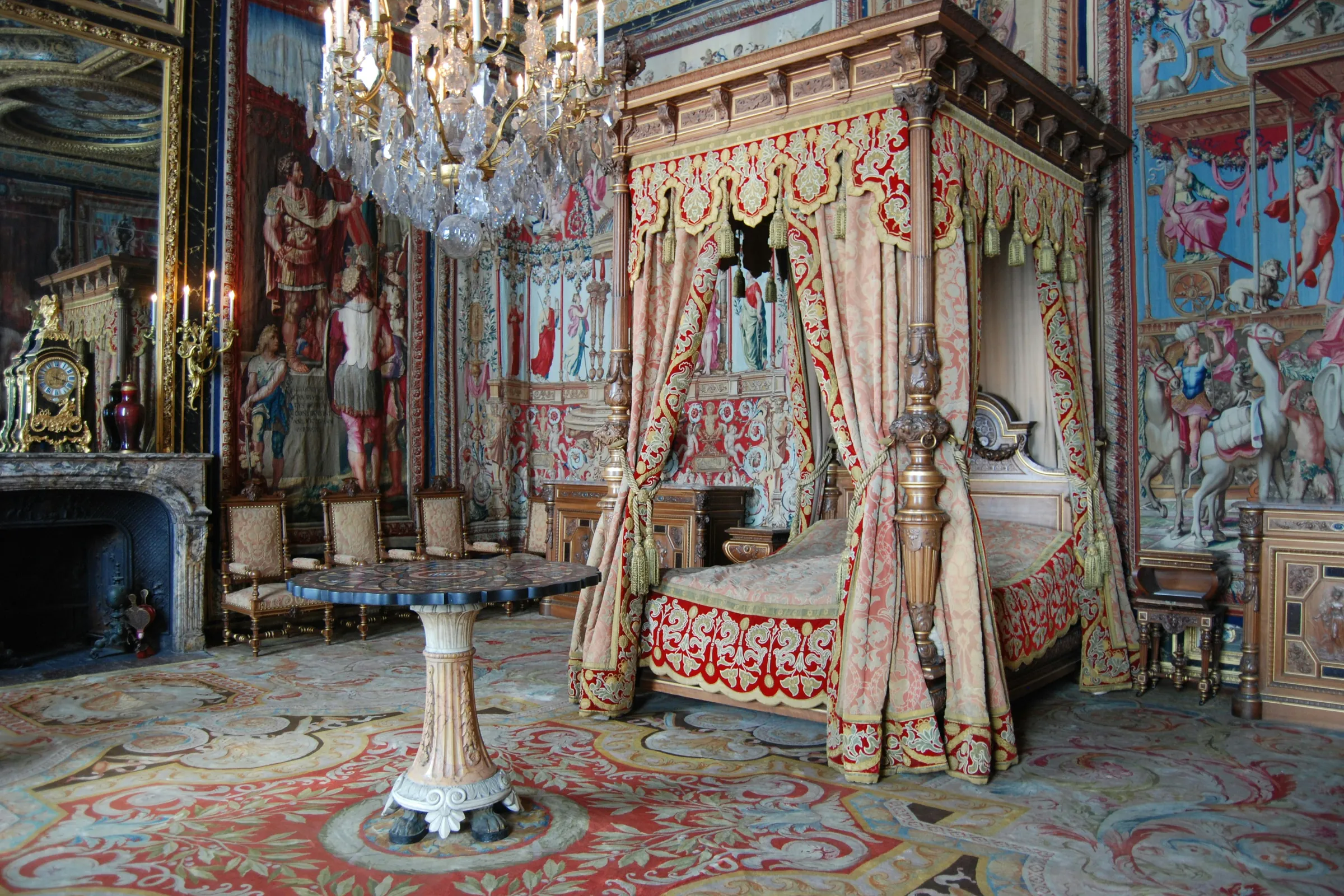
Among the most striking of Napoleon's interiors is the throne room, which he installed in what had been a royal bedchamber — the only surviving imperial throne room in France. Refitted in rich Empire style with a canopy and throne, it staged the formal audiences of the regime and remains one of the clearest expressions of how Napoleon adapted a royal palace to imperial ceremony. Nearby is the small, intimate bedroom traditionally associated with the act that ended his first reign.
In April 1814, with the allied armies closing in, it was at Fontainebleau that Napoleon abdicated. The episode took place over several days within the palace, and the abdication room is shown as part of the imperial apartment route. Visiting these rooms gives the historical context for the famous scene that followed outside — the abdication that forced the Emperor's departure for exile and set up his emotional farewell to his soldiers in the great forecourt the next day.
The Farewell on the Cour des Adieux
The most famous moment in the palace's history played out in its great forecourt. On 20 April 1814, having abdicated, Napoleon descended the curved double horseshoe staircase and made an emotional farewell to the assembled soldiers of his Imperial Guard before leaving for exile on the island of Elba. He embraced the eagle standard and addressed the men who had followed him across Europe — a scene so charged that the courtyard has been known ever since as the Cour des Adieux, the 'Courtyard of Farewells'.
The courtyard is also called the Cour du Cheval Blanc, the 'Courtyard of the White Horse', after a plaster horse that once stood there. Standing on or before the horseshoe staircase today, with the long palace façade behind, is the closest a visitor comes to stepping inside the Napoleonic legend — and it is free, since the forecourt and gardens cost nothing to enter. It is the signature exterior view of Fontainebleau, and the place where the palace's history and the Emperor's story most vividly meet.
The Musée Napoléon Ier
To complete the Napoleonic visit, the Musée Napoléon Ier, set within the palace, gathers the personal possessions of the Emperor and his family — uniforms, arms, decorations, porcelain, silver and gifts — across a series of rooms. It gives the human detail behind the legend: the everyday objects, the ceremonial regalia, and the belongings of the imperial household. For anyone whose interest in Fontainebleau is led by Napoleon, it is a museum in its own right within the larger palace and well worth allowing time for.
Together with the throne room, the abdication apartment and the farewell courtyard outside, the museum makes Fontainebleau the most complete Napoleonic palace in France. Add the Imperial Theatre — the jewel-box auditorium completed under Napoleon III — and the palace carries the imperial story right through to the Second Empire. A visit that follows Napoleon through these spaces, and ends on the staircase of the Cour des Adieux, traces one of the most dramatic arcs in French history within a single building.
Frequently asked
Why is Fontainebleau associated with Napoleon?
It was his favourite palace, which he restored and refurnished as a working imperial residence after the Revolution. It holds his apartments, the only surviving imperial throne room in France, and the Musée Napoléon Ier, and it is where he abdicated and made his famous 1814 farewell.
Where did Napoleon make his famous farewell?
On the curved horseshoe staircase in the great forecourt, on 20 April 1814, after his abdication. He bid farewell to his Imperial Guard before leaving for exile on Elba — which is why the courtyard is called the Cour des Adieux, the 'Courtyard of Farewells'.
What is the Cour des Adieux?
The great forecourt of the palace, named for Napoleon's 1814 farewell to his guard there. It is also called the Cour du Cheval Blanc, the 'Courtyard of the White Horse', and its horseshoe staircase is the signature exterior view of Fontainebleau.
Can I see Napoleon's throne room?
Yes — Napoleon installed a throne room in a former royal bedchamber, the only surviving imperial throne room in France. It is part of the Napoleonic apartment route inside the palace, subject to the day's opening.
What is in the Musée Napoléon Ier?
The personal possessions of Napoleon and his family — uniforms, arms, decorations, porcelain and gifts — across a series of rooms within the palace. It gives the human detail behind the imperial legend.
Did Napoleon abdicate at Fontainebleau?
Yes — his first abdication took place at Fontainebleau in April 1814, within the palace. The abdication apartment is shown as part of the imperial route, and the farewell to his guard followed in the forecourt the next day.
Is the Cour des Adieux free to visit?
Yes — the great forecourt and the gardens cost nothing to enter, so you can stand before the horseshoe staircase where Napoleon said farewell without a palace ticket. The ticket is needed only for the apartments and museums inside.