 Skip-the-line available
 What to See Inside Château de Fontainebleau
The Gallery of Francis I, the Napoleon apartments and museum, the ballroom and the gardens — what to prioritise and in what order.
Fontainebleau is enormous and layered — eight centuries of royal and imperial rooms arranged around a sequence of courtyards — but the visit organises itself around a handful of unmissable spaces, and a clear order of priorities turns a sprawling palace into a satisfying half-day. The pleasure here is the accumulation of history: a Renaissance gallery, royal state rooms, Napoleon's apartments and museum, and gardens that frame the whole. This guide walks through what to see, in what order, and how to spend your time so you reach the best spaces with energy to spare.
The Gallery of Francis I
Begin with the room that made Fontainebleau famous. The Gallery of Francis I, created in the 1530s, is the first Renaissance interior in France and the single most important space in the palace. Italian masters led by Rosso Fiorentino and Primaticcio combined painted fresco with sculpted stucco frames and figures in a single scheme — a technique new to France — wrapping mythological scenes in three-dimensional plaster that seems to spill from the walls. Walk its full length slowly; the more closely you read the interplay of paint and stucco, the clearer the leap French art made here becomes.
This is the room that gave its name to the 'School of Fontainebleau' and set the course of French decorative art for generations. For art-minded visitors it is the highlight of the whole château, and it deserves more time than its modest size suggests. Look up at the carved and gilded ceiling, and note the salamander emblem of François I worked through the decoration — the mark of the king who brought the Renaissance to France and built this gallery to prove it.
The Grands Appartements and the Ballroom
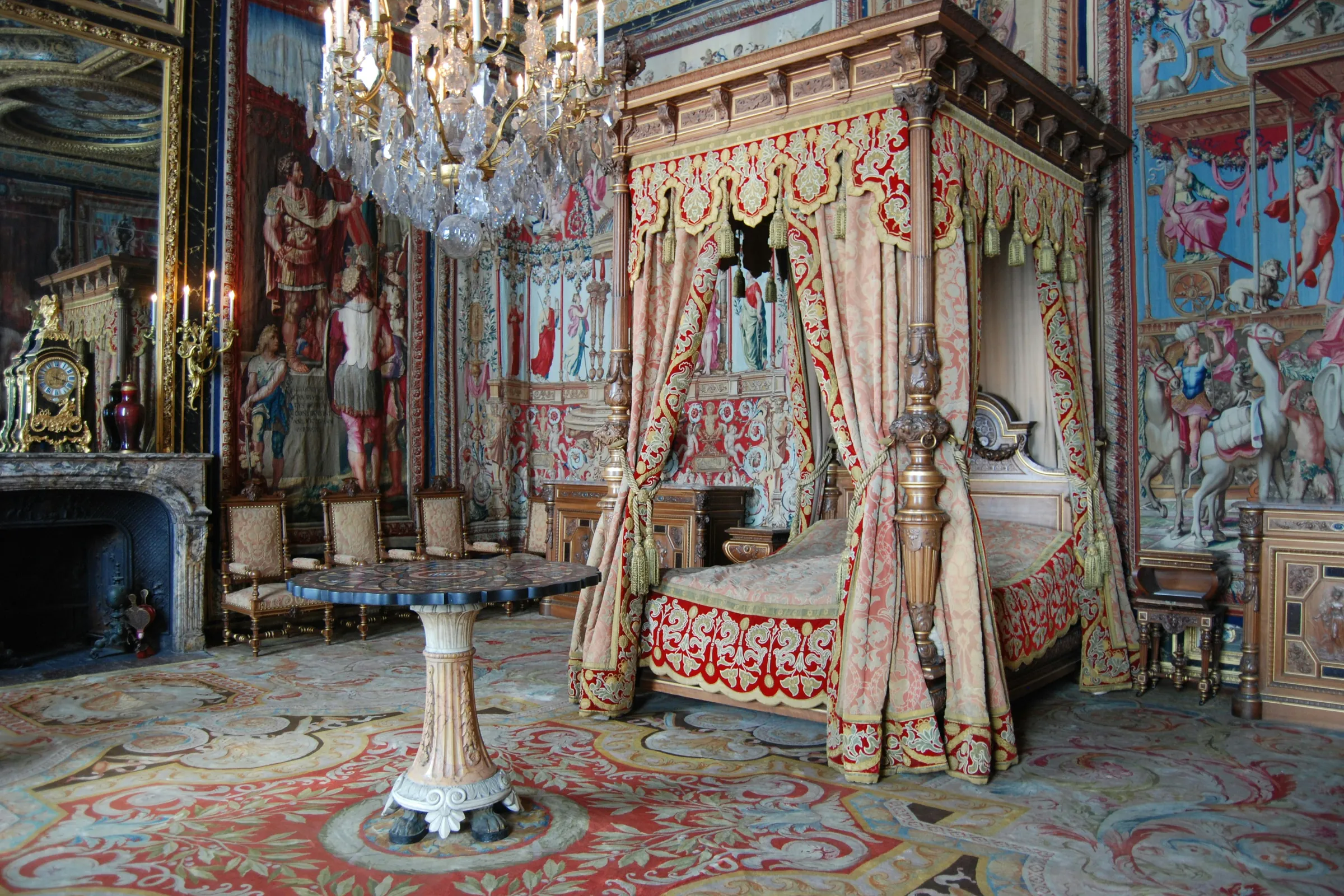
From the gallery, work through the Grands Appartements — the great state and royal apartments that successive sovereigns furnished and refurnished over centuries. The sequence includes the magnificent ballroom of Henri II, a long coffered-ceiling hall frescoed by Primaticcio and his workshop, with a monumental fireplace and tall windows looking onto the gardens; it is one of the grandest Renaissance interiors in France and a natural companion to the Gallery of Francis I. Beyond it lie the royal apartments, the council chamber and the chapel, each layered with the taste of different reigns.
Because Fontainebleau was lived in continuously, these rooms read as an accumulation rather than a single scheme — Renaissance, Bourbon and Napoleonic decoration sit side by side, and part of the pleasure is tracing how each era left its mark. Move through at a steady pace, lingering at the ballroom and the most richly decorated chambers; they are the connective tissue between the Renaissance gallery and the Napoleonic rooms that follow, and they give the fullest sense of the palace as a living royal house across the centuries.
The Napoleon Apartments and the Musée Napoléon Ier
Fontainebleau holds one of the richest concentrations of Napoleonic interiors anywhere, because the Emperor restored and refurnished the palace as a working residence of the First Empire. Look for the throne room, which Napoleon installed in a former royal bedchamber — the only surviving imperial throne room in France — and the small bedroom associated with his abdication. These rooms put you directly inside the Napoleonic story in a way few palaces can, and they pair naturally with the great farewell scene outside in the Cour des Adieux.
The Musée Napoléon Ier, set within the palace, gathers the personal possessions of the Emperor and his family — uniforms, arms, decorations, porcelain and gifts — and gives the human detail behind the legend. Allow time here if the Napoleonic era draws you; it is a museum in its own right within the palace. Together with the Imperial Theatre, the jewel-box auditorium completed under Napoleon III, these spaces add the imperial and Second-Empire layers that make Fontainebleau's history feel continuous right up to the 19th century.
The Gardens, the Grand Parterre and the Carp Pond
Don't leave without stepping outside. The gardens at Fontainebleau are free and frame the palace beautifully: the Grand Parterre, one of the largest formal parterres in Europe, is a vast geometric sweep best read from a little distance or from the palace windows above; the romantic English garden and the Diana garden, with its bronze fountain, offer quieter corners; and the long carp pond, with its small island pavilion, reflects the façades in still water. A slow loop here, ideally at the start or end of your visit, frames the building far better than any view from up against its walls.
Because the gardens and the surrounding Forest of Fontainebleau are free and open daily, they extend the visit naturally — an hour among the parterre and the carp pond, or a longer walk into the woods, transforms a two-hour interior tour into a relaxed half or full day. The best light for the pond and the parterre comes in early morning and the golden hour before close. For families and anyone wanting air after the dense decorated rooms, the grounds are as much a part of Fontainebleau as the gallery and the apartments.
Frequently asked
What is the must-see inside Fontainebleau?
The Gallery of Francis I — the first Renaissance interior in France — and the Napoleonic rooms, including the throne room and the Musée Napoléon Ier. The Henri II ballroom and the gardens round out the highlights.
What is the Gallery of Francis I?
A 1530s gallery that is the first Renaissance interior created in France, decorated by Italian masters who combined fresco with sculpted stucco. It gave rise to the 'School of Fontainebleau' and is the palace's most celebrated room.
What is the Musée Napoléon Ier?
A museum within the palace gathering the personal possessions of Napoleon and his family — uniforms, arms, decorations and gifts. It gives the human detail behind the Napoleonic legend and pairs with the Emperor's apartments and throne room.
How long do I need inside?
Allow about 2 hours for the Grands Appartements, the Gallery of Francis I and the Napoleon museum. Add an hour or more for the gardens and the carp pond, all of which are free.
Can I see Napoleon's throne room?
Yes — Napoleon installed a throne room in a former royal bedchamber at Fontainebleau, and it survives as the only imperial throne room in France. It is part of the Napoleonic apartment route inside the palace, subject to the day's opening.
Are the gardens included in the ticket?
The gardens, the Grand Parterre and the park are free and need no ticket at all — open daily, even when the palace is closed. Your château ticket is needed only for the apartments and museums inside.
What should I see first?
Start with the Gallery of Francis I and the Henri II ballroom, then work through the Grands Appartements to the Napoleon apartments and museum, and finish outside in the gardens for the best light and the full view of the palace.
Is it interesting for children?
Yes. The Napoleon museum, the throne room and the Imperial Theatre bring the history to life, and the free gardens and nearby forest give kids space to roam. Pace the indoor part and leave time outdoors.